
From peelings to produce
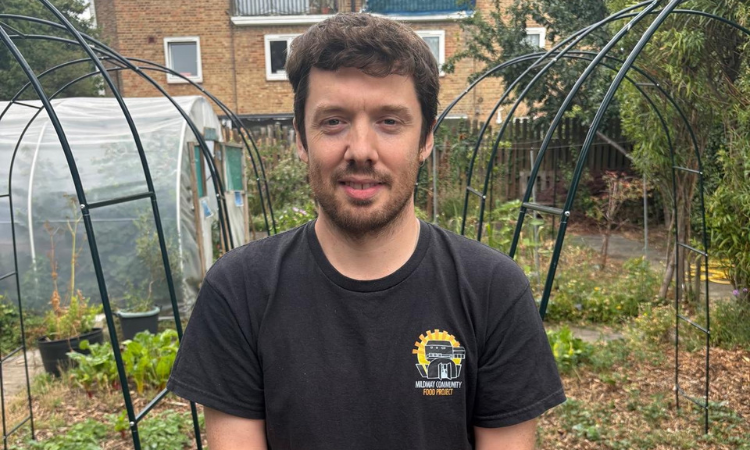
Most people in Islington recycle their food waste, but an exciting project at Mildmay Community Centre is transforming what happens with that waste. We speak to Dom, Food Project Co-ordinator.
‘The Community Composting project has created a space that allows local people to process their food waste locally, and convert it into a high quality, biologically active compost.
‘Residents drop their food waste off; we mix it with woodchip and leave it in large containers with holes in the bottom. Worms enter the bin from the ground, and work their way through the food waste, digesting it. We then leave it for a year to mature and develop in complexity – just as you would with wine or cheese! Its complex in its microbiology, and that what our soils are missing and what you need to grow good food in.
Once its ready, people can come and collect the finished compost that they can then take back to use on window boxes or gardens. If they prefer, they can donate it to the project, and we give them some freshly grown produce, or seeds from the seed bank, in return.
‘As well as being free, its quality means it is also far better adapted to climate change – great soil retains moisture so is better during a drought, and if there is too much rain it soaks it into the ground rather than letting it run off and overwhelm the drains. It would cost about £100 for 25 litres of equivalent quality compost! Its great to be able to create this valuable resource within the community.
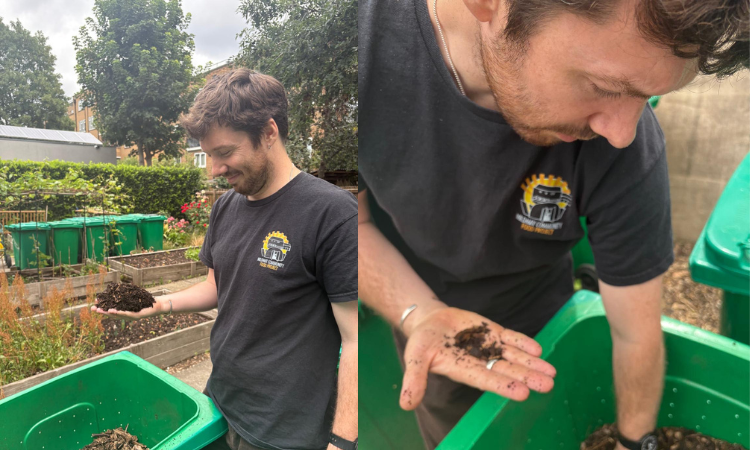
Dom with some finished compost
‘Many of us growing up in cities have never had the opportunity to grow food, we’ve lost our connection to the land. Why would I need to grow stuff when I get my food from the shop? I was 29 by the time I ate something that I grew myself. When you begin to grow food, you realise that we are connected to the land – and that realisation means that we depend on it are more likely to look after the environment as it sustains us.
‘Really, food waste is a valuable resource to be upcycled, rather than something to be treated as waste. It’s not something to get rid of, it’s an essential resource for building good quality soil, which in turn grows good quality and nutritious food. We need to develop ways to catch that resource locally so we can realise benefit from it. Previous generations would have had access to compost piles. It’s not a new thing; it’s reconnecting with old practices. The project we are doing here is a great way for local communities to benefit from recycling their food waste.
‘We find that local people pop in and chat, ask us what is happening and what it’s all about. People share knowledge and learn more about the process of upcycling food waste and begin to understand that it’s not food waste – it’s a resource.
‘Through this process, people also create new social connections, meet people from their estate, and friendships are made.’
Mildmay community composting project is part of a pilot project, along with Octopus Community Network, which is funded by NLWA.

